Home / Research
AI writes code faster. Tasks don't close any faster
Large studies from 2025–2026 agree: the bottleneck has moved from writing code to review, rework and finding context. Here are the key numbers, with caveats about each source.
| What was measured | Result | Source and caveat |
|---|---|---|
| Top complaint about AI tools | 66% of developers say AI solutions are "almost right, but not quite," and 45% say debugging that code takes longer | Stack Overflow Developer Survey 2025, 49k responses, self-reported |
| Perception vs. measurement | Experienced developers believed AI made them about 20% faster. Measured, they were slower | METR, 2025, controlled experiment, 16 developers |
| Code vs. tasks | Across 700+ companies, code volume grew 30%, closed tasks stayed statistically flat, and review time grew 49% | Harvard, October 2026, working paper |
| Waiting for review | A PR from an agent waits 17.6 hours for review to start, vs. 3.4 hours for a regular PR | LinearB Benchmarks 2026, 75th percentile, 8.1M PRs |
| Review comments | 10.83 issues per AI-assisted PR vs. 6.45 per human-written PR | CodeRabbit, December 2025, 470 PRs, data from an AI code review vendor |
| Code reuse | The share of refactoring fell from 25% to under 10%, and copy-pasted code rose from 8.3% to 12.3% | GitClear 2025, 211M changed lines |
| Finding information | Half of developers lose more than 10 hours a week. The top reason is searching for information about the project | Atlassian, State of DevEx 2025, 3,500 respondents |
When AI actually pays off
Google's DORA 2025 report calls AI an amplifier: it magnifies a team's strengths and its weaknesses alike. One of the conditions for real results is giving agents access to the company's internal documentation and code. That is what AI Council does.
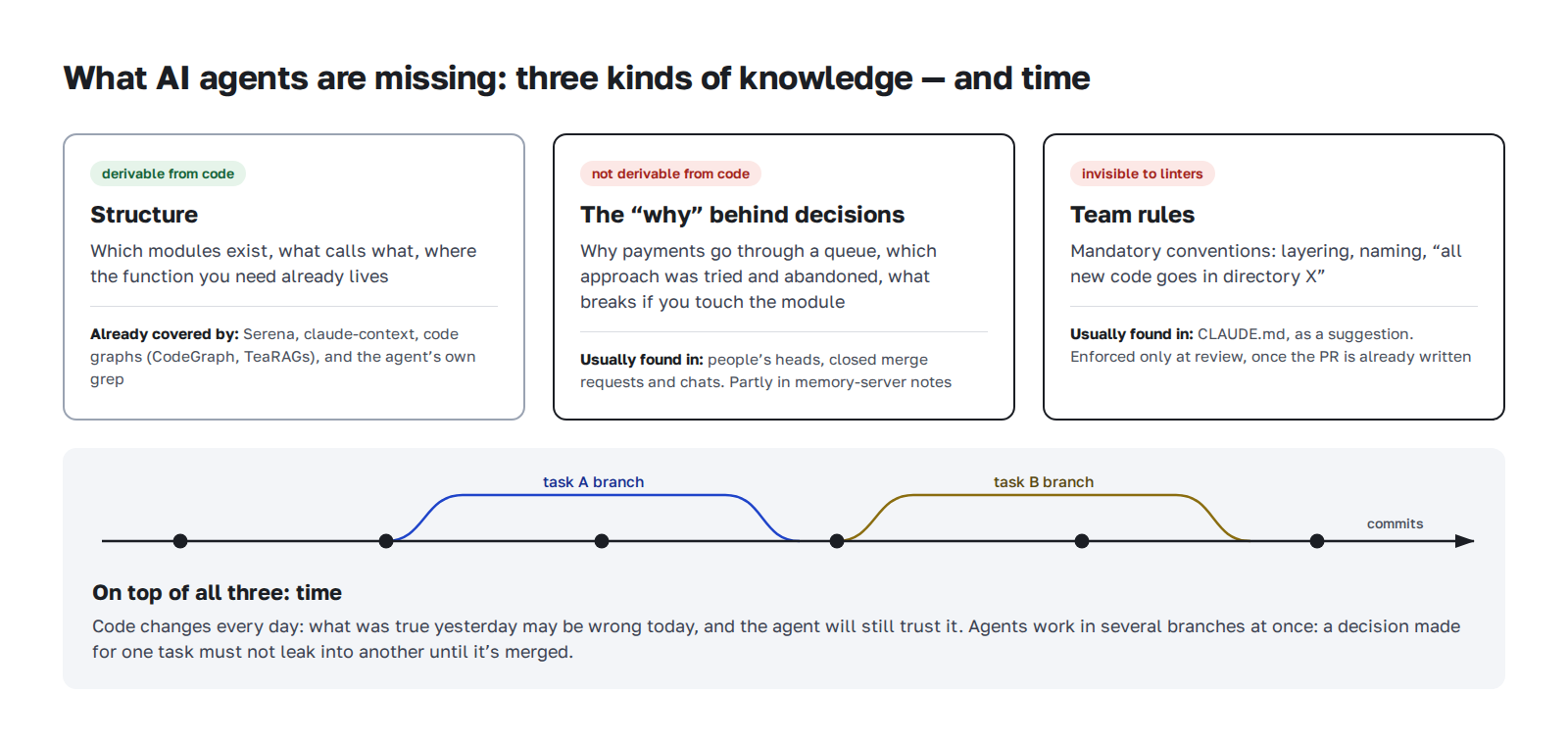
What the agent is missing
Nearly every review comment on agent-written code comes down to three kinds of knowledge, plus time.
Our measurements
- 1 dayinstead of 2–3 weeks before a new developer starts taking tasks
- 30–45%time and tokens saved on a single task. Clean test: same task, project and agent, with and without AI Council
- 40–60%saved on a group of tasks when a team of developers and several agents work on them
These are our own measurements, not an independent study. Check them on your project.
Check it on your own project
Record a baseline before you connect AI Council, then compare after 4–6 weeks.
